
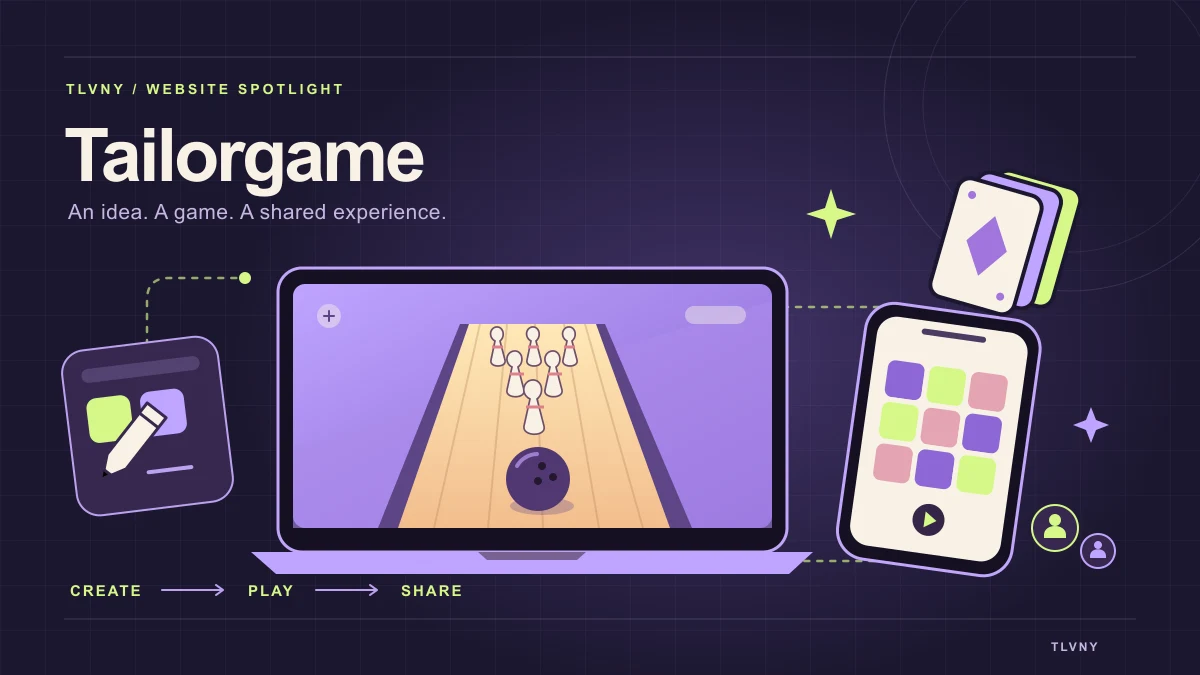
Tailorgame makes an appealing proposition to anyone who has ever finished a game and immediately imagined a different version: put that idea into words, shape the rules, and explore what it could become. Alongside its browser games, the new platform offers a creation Studio and invitation-based rooms, bringing players and aspiring creators into the same playful environment.
That combination gives Tailorgame a futuristic feel. The starting point for making a game can be a description rather than an empty code editor. The starting point for playing can be a website rather than a download. The social invitation can be a room link rather than a complicated setup. Together, those choices suggest a more personal, participatory kind of online playground.
The attraction is easy to understand: a player can discover a quick challenge, chase a personal best, and start thinking like a designer. A creator can begin with a small idea and organize its appearance, mechanics, and scoring before attempting a browser prototype. Friends can use a private room to gather around a chosen game and, where access is granted, reach a private creation.
Website spotlight, reviewed November 6, 2026. Tailorgame is in early access. This feature ranks five catalog picks by their published concepts, accessibility of the idea, and fit with the platform; it is not a play-tested review or a popularity chart. Three picks are listed as playable and two are explicitly coming soon. We inspected the public site and documentation without creating an account or testing signed-in gameplay. The About page also confirms that rooms do not yet synchronize live gameplay.
A playground with room for both players and creators
Tailorgame's most interesting idea is the relationship between enjoying a game and imagining one. Those activities can feed each other. A bowling challenge introduces questions about timing and precision. A matching game makes memory and move counts feel tangible. A color challenge invites attention to visual clarity. After a few encounters with simple rules, the question becomes almost automatic: what would I change?
The platform gives that question a destination. Its published product description places the game catalog, creation Studio, practice rankings, and invitation rooms within one service. Users can approach it as players, explore it as creators, or move between those roles. That is a compelling foundation for a community because participation can begin with a modest commitment: one short game or one clearly expressed idea.
For players, the appeal is immediacy and variety within a small collection. For creators, it is a guided way to make decisions that are easy to overlook when an idea is still vague. What does the player control? What counts as success? How does a run end? A useful creation tool helps answer those questions before visual ambition overwhelms the actual game.
The result is an inviting vision of game creation as an everyday creative activity. Someone who would happily write a story, sketch a character, or invent a challenge for friends may also have a game worth exploring. Tailorgame's Studio offers a place to begin that exploration.
Our five Tailorgame catalog picks, ranked
Neon Bowling takes our number-one spot as the clearest introduction to Tailorgame's personality. We place the three currently playable originals first, then choose two upcoming concepts for the watchlist. The ordering favors an understandable premise, a distinct skill focus, and potential to spark ideas in a new creator. It does not imply measured performance, player satisfaction, or proven popularity.
The public catalog distinguishes available games from future releases. At review time, the public rankings contained no completed entries from which to establish a meaningful community top five. This is therefore an editorial starting guide, with availability treated as part of the recommendation.
| # | Game | Status at review | Why it makes our list |
|---|---|---|---|
| 1 | Neon Bowling | Listed as playable; sign-in required | The strongest opening showcase for timing, aim, and personal-best challenges. |
| 2 | Card Clash | Listed as playable; sign-in required | A familiar matching premise with memory, strategy, and move efficiency. |
| 3 | Color Rush | Listed as playable; sign-in required | A bright matching concept suited to a quick, focused challenge. |
| 4 | Pocket Pool | Coming soon; watchlist pick | An angle-focused arcade concept with an immediately recognizable theme. |
| 5 | Speed Chess | Coming soon; watchlist pick | A strategy concept that could broaden the collection's range. |
1. Neon Bowling: the signature starting point
Neon Bowling earns first place because its published premise communicates the platform's appeal particularly well: aim, choose a release, and pursue a better result. The homepage also gives it a prominent daily-challenge position, making it the natural first stop for someone exploring the collection.
Bowling is an effective theme for a browser skill game because the goal is recognizable before a player studies detailed instructions. It also gives a new creator a concrete way to think about design. An input, a visible action, and a score form a compact loop. Small changes to timing or difficulty could change the character of a challenge without requiring a sprawling fictional world.
The official bowling guide adds a concrete format: five rolls, up to ten pins per roll, and a maximum score of 50. Release timing against a moving marker determines the result. That gives the published concept a clear rhythm and a measurable personal target. The public detail panel labels it as a free, single-player arcade game and requires sign-in to play.
2. Card Clash: a familiar idea with a thoughtful hook
Card Clash comes second for its accessible memory-and-strategy premise. Its public description centers on matching a deck while minimizing moves. That gives players a straightforward objective and an understandable measure of improvement: achieving the same task more efficiently.
The concept also shows why small games can be fertile creative material. A matching challenge can inspire questions about the size of a deck, the information a player sees, and the balance between recognition and recall. Those are useful design questions even before anyone considers elaborate animation or a complex story.
The official Card Clash guide describes twelve cards forming six pairs, with fewer moves producing a higher score and no countdown. That format invites deliberate observation. For someone entering Tailorgame primarily as a creator, it is an approachable reference point for describing a mechanic precisely: define the matching objective, explain how moves affect the result, and make success understandable.
Card Clash is listed as a free, single-player card game. Its place above Color Rush reflects our preference for a particularly clear efficiency goal, rather than a claim that it has better measured engagement.
3. Color Rush: a vivid invitation to focus
Color Rush takes third place with a public description built around color, memory, and making matches. Its bright visual identity gives the launch collection a different entry point from the bowling lane and the deck of cards.
For a player browsing for something brief, a visually legible matching concept can be an appealing proposition. For a creator, it raises a valuable question: how much of a game's challenge comes from recognizing information, and how much comes from remembering it? A concise brief needs to express that distinction if the resulting prototype is to resemble the creator's intention.
We rank Color Rush for its concept and the contrast it brings to the catalog. Its public detail panel identifies it as a free, single-player arcade game. Alongside Neon Bowling and Card Clash, it gives a first-time visitor three recognizable themes to explore before turning toward an original idea.
4. Pocket Pool: our first upcoming game to watch
Pocket Pool is coming soon, so this position recognizes the idea rather than an available game. The catalog places it in the arcade category and presents an angle-oriented pool theme. That is enough to make it an interesting addition to a collection already anchored by bowling.
We choose it as our fourth pick because pool offers a familiar relationship between direction, position, and an intended outcome. In editorial terms, it is an accessible way to extend the collection's precision theme. It also provides a useful contrast with a memory game: a player is invited to think spatially.
No conclusions about shot control, table physics, competitive modes, or release timing follow from that listing. Those details require a released product and hands-on evaluation. For now, Pocket Pool belongs on a watchlist. Readers looking for a game they can start today should choose one of the first three entries.
5. Speed Chess: a strategic direction for the collection
Speed Chess is also coming soon. We place it fifth because a chess-themed strategy entry would broaden the catalog beyond its current arcade and card emphasis. The published listing establishes the name, strategy category, and upcoming status; it does not establish a finished ruleset or multiplayer implementation.
Its attraction is the possibility of a different kind of attention. A bowling theme suggests execution; a matching theme suggests recall; a chess theme suggests evaluating choices. That variety could help players discover which kind of challenge they enjoy and give creators more ways to think about meaningful decisions.
We are not claiming that Speed Chess currently provides clocks, matchmaking, rated play, chess-engine analysis, or verified competition. None of those features should be inferred from the title. The catalog also lists Neon Drift as an upcoming racing entry. We selected Speed Chess for this five-pick guide because the strategy category adds a particularly distinct concept.
Inside the Studio: turning an idea into a game brief
The creation Studio is the part of Tailorgame that most directly expresses its forward-looking ambition. According to the About page, it helps users describe an idea, visual style, perspective, mechanics, and scoring. Saving that work produces a private, editable brief at no charge.
That intermediate step has real creative value. Many game ideas begin as atmosphere: a floating city, a mysterious garden, a strange bowling alley. Atmosphere gives the project personality, but the designer still needs to decide what a player actually does. A brief connects those two levels, turning an attractive setting into a set of intentions that can be reviewed.
Imagine an original concept for a tiny rooftop delivery challenge. A useful description might explain that the player guides a bicycle between marked stops, earns points for accurate deliveries, and loses points for missed destinations. The visual direction could call for a flat illustrated city with large, readable controls. This is an example we devised to show how a brief might be structured, not a game confirmed in Tailorgame's catalog.
The next useful questions are specific. Does a round end after a fixed number of deliveries? What action moves the bicycle? How does the player know a delivery succeeded? Should the first round introduce one challenge at a time? Answering those questions creates a clearer target for any prototype and makes the creator's own thinking more precise.
For an aspiring designer, this is an encouraging place to start. The work can remain small enough to inspect. A creator can revise a rule before attempting generation, keep an idea private, and focus on one enjoyable interaction. The Studio's promise is especially compelling when understood as a way to support those decisions.
AI-assisted prototypes give imagination a practical next step
The Studio overview names Gemini as the technology used for browser prototype generation. The more detailed product explanation makes the sequence clear: when generation is enabled, a saved brief can become a separate playable browser prototype after the creator reviews a credit quote. A brief alone remains a draft.
This is where the futuristic idea becomes concrete. Natural language can carry instructions about appearance and behavior into an attempt at interactive software. That potentially shortens the distance between describing a small game and having something to inspect. The creative opportunity lies in the feedback: does the result express the rule the creator intended, and what should change next?
Prototype is an important word. A generated attempt should be evaluated for clarity, functionality, and enjoyment. A game that appears visually impressive may still need clearer goals. A simple-looking game may have a satisfying central interaction. Creators can use an early result to discover that difference instead of treating the first generation as a finished release.
The site cautions that detailed realistic assets are not guaranteed and directs users to check availability and maximum credit cost in the Studio. Those boundaries help define a sensible first project: a compact idea with a clear objective and a manageable visual style. The innovation is the opportunity to attempt a playable interpretation of that idea, with the creator continuing to make judgments about the result.
Game night, sharing, and the pleasure of inviting friends
Games often become more memorable when there is someone to compare notes with. Tailorgame builds that social impulse into invitation-based rooms. Its About page says a room supports up to four members and can be shared through a code or link, including when the room grants access to a private game.
That gives creators a particularly interesting possibility: a small intended audience. An idea does not have to launch to an anonymous crowd to be worth making. A private creation can be interesting because a few friends understand its theme, appreciate its joke, or want to explore the challenge. The room model gives that kind of invitation a defined place.
The present capability has a clear limit. Rooms preserve membership and access; they do not synchronize live gameplay. Tailorgame also states that synchronized multiplayer is not connected. Friends can use the invitation structure to reach a game, but readers should not expect real-time shared physics, simultaneous turns, or live opponents merely because they are in the same room.
For a current game night, the sensible expectation is a shared destination for individual play and conversation. Friends might agree to try the same challenge and discuss their experiences in their usual chat. That is a suggested way to use a small game socially, rather than a claim that Tailorgame currently supplies voice chat or a synchronized tournament system.
Even within that scope, the social direction is appealing. Making the invitation part of the product connects the creator's work with the people who might enjoy it. The platform's future appeal will depend in part on how clearly it continues to distinguish those access features from any richer multiplayer capabilities it may introduce.
Browser access makes the playground easier to reach
Tailorgame's homepage emphasizes browser play without downloads, and its About page describes a browser skill-game platform. That web-based approach is central to its broad appeal. A URL can carry an invitation to a game in the same familiar way that it carries an invitation to read an article or open a shared page.
For creators, a browser destination can simplify the explanation of where an audience should go. For players, it can reduce the steps between hearing about a game and inspecting it. Those are meaningful design advantages for small, spontaneous experiences, where a long installation process could consume more attention than the game itself.
The idea is a playground reachable wherever a suitable browser and connection are available. That is an ambition for broad access, not a verified promise that every game works on every phone, tablet, computer, browser, or network. We did not run a device-compatibility matrix, and input requirements can matter as much as loading the page.
Anyone planning to invite a group should check the chosen game on the devices their friends will use. The same practical step applies to an original prototype. A concept built around a keyboard may need a different input design for a phone. Thinking about the audience's screen and controls is part of making the invitation welcoming.
Why Tailorgame's approach feels innovative
Our reading of Tailorgame is that its strongest innovation lies in connecting several ordinary actions into a creative loop: discover a game, understand a simple rule, describe a new idea, attempt a prototype, and invite people into its orbit. The individual actions become more interesting when a user can move between them within one environment.
First, the Studio treats language as a useful starting material for interactive design. A creator can express intent before knowing how to implement every detail. That can open the door to people whose strengths are storytelling, illustration, teaching, or inventing challenges. Implementation still matters, but the first creative decision can be an idea stated clearly.
Second, the small-game focus encourages a manageable scale. A satisfying game does not always require a vast world. A readable goal, a meaningful action, and a reason to try again can be enough to begin. For an early creator, that scale makes it easier to ask useful questions about what works and what needs revision.
Third, the player and creator roles reinforce each other. Playing can supply a vocabulary for design. Designing can make someone a more attentive player. A person who has tried to explain a scoring rule may notice clarity in another game's feedback; a person who enjoys a quick challenge may discover an idea for a new one.
Finally, invitation-based access recognizes that a game's first audience might be personal. A small circle can give a creator a reason to finish an experiment. Friends can supply context, encouragement, and observations about confusing instructions. Those are possible benefits of the product's structure, rather than measured outcomes we can attribute to its current user base.
This is what makes the platform worth watching: it presents a plausible route toward more people participating in the making of games. Its potential will be demonstrated through the quality of playable results, the clarity of the creation process, and the experiences people actually share.
A discovery layer for the next generation of web tools
Tailorgame also has a forward-looking side beyond its visual playground. Its developer documentation describes free, read-only REST and MCP interfaces for public game information, practice rankings, and documentation. These provide structured ways for software tools and compatible AI assistants to discover what the platform offers.
That matters because a useful game recommendation needs more than a name. It needs to know whether a title is playable, which category it belongs to, and what the published information actually supports. A structured catalog can make those distinctions easier for another tool to preserve. An upcoming listing should remain upcoming as it travels beyond the homepage.
This is a promising complement to AI-assisted creation: tools can help people discover public experiences as well as help creators express new ones. The documented interfaces are read-only and concern public information; they should not be interpreted as giving an assistant permission to spend credits or act inside someone's account. Their value here is a clearer, more connected discovery layer around the games.
What is free, and how creation credits work
Tailorgame's current availability statement says that playing supported games and saving briefs are free. The homepage advertises 100 starter demo credits for new accounts. Those credits support experimentation; they have no cash value, and paid credit purchases are not currently available.
The pricing section shows a proposed conversion of 100 credits per US dollar and example bundles, while clearly marking checkout as coming soon. Readers should treat those figures as published pricing information for the planned purchase flow, not as an active checkout offer.
For generation, the site describes a bounded credit estimate that the user reviews before starting. Credits are reserved against that budget, consumed usage is settled, and unused credits are returned. Usage can still be charged when a generation attempt is unsuccessful. That makes reviewing a quote part of the creative decision, especially when refining an ambitious brief.
A useful first visit therefore has a modest path: explore the available catalog, save an original brief, and examine the current Studio options before attempting generation. There is room to learn about the process before deciding how to spend a demo balance.
A practical first visit for players and creators
For players
- Open the game catalog. Start with Neon Bowling, Card Clash, or Color Rush; check the availability label on other titles.
- Sign in when prompted to play. The public site explains that completed scores can be saved to track progress.
- Use rankings as practice context. The site states that scores are reported by browsers and are not verified competitive results.
- Invite friends with accurate expectations. Rooms support membership and access for up to four people; live synchronized multiplayer is not connected.
For creators
- Begin with one clear action. Describe what the player does, what they are trying to achieve, and how they know they have succeeded.
- Use the Studio to shape the brief. Add visual direction, perspective, mechanics, and scoring. Keep the first idea small enough to assess.
- Save and review the private draft. A saved brief preserves the design; it does not by itself create a playable game.
- Check generation availability and the credit quote. When enabled, generation produces a separate browser prototype to inspect and evaluate.
- Check access before sending an invitation. Use the documented room flow when granting intended friends access to a private game, and assess the experience on their devices.
Questions readers may have before joining
Are there five games available to play right now?
At our November 6 review, three originals were listed as playable: Neon Bowling, Card Clash, and Color Rush. Our five-pick ranking includes Pocket Pool and Speed Chess as clearly labeled upcoming selections. Neon Drift was also marked coming soon. Check the live catalog for changes.
Can a player also become a creator?
Yes. Tailorgame offers both a game catalog and a Studio for private game briefs. The published workflow says that, when generation is enabled, a saved brief can be used to attempt a separate playable browser prototype after a credit quote is reviewed.
Can friends play together online?
They can join invitation-based rooms with up to four members, including rooms that grant access to private games. The current rooms preserve membership and access. They do not synchronize live gameplay, so the service should not yet be described as offering fully connected real-time multiplayer.
Is Tailorgame available everywhere?
It is web-based and promotes no-download browser access. That makes it easy to point people to the site, but universal device, country, network, or browser compatibility has not been established by this review. Check the actual game, its controls, and current access conditions for your intended audience.
Is our ranking based on player numbers?
No. It is an editorial ordering of three available concepts and two upcoming ones. The public rankings had no completed entries at review time. We did not use decorative homepage activity displays as evidence of audience size, and we did not conduct signed-in gameplay testing.
A small invitation to a more creative gaming future
Tailorgame's appeal comes from the feeling that a game can be something you discover and something you help imagine. Its current collection gives players a few clear starting points. Its Studio gives creators a way to organize an idea. Its private rooms connect an invitation with access, laying the groundwork for a more social creative experience.
The early-access boundaries are part of the picture: a brief is a draft, generation depends on availability and credits, upcoming titles are still upcoming, and rooms do not yet provide synchronized multiplayer. Within that honest scope, the direction remains exciting. A platform that helps someone move from enjoying a small challenge to expressing an original one has a meaningful creative proposition.
Start with Neon Bowling to explore our first catalog pick, or open the Tailorgame Studio with a compact idea of your own. The most interesting possibility is the next game someone will be inspired to imagine.
Sources and scope: Tailorgame homepage and game detail panels, public catalog, About and current availability, developer documentation, and public rankings, reviewed November 6, 2026. Availability, generation options, and pricing information can change. Rankings and interpretations are TLVNY's editorial selections.