TEL AVIV — PLANETech Week begins on October 18, 2026, with a Tel Aviv programme that puts a practical question in front of climate technology founders: how does a promising invention become something customers will finance, buy and operate? The five-day series runs through October 22, combining investor meetings, company visits and workshops across Israel.
A September 1 notice from the Cyprus Employers and Industrialists Federation also announced the October 18–22 dates. Tel Aviv is a hub for several of the week's commercial discussions. The Israeli Ministry of Foreign Affairs' event notice identifies energy, water, agriculture, mobility, materials and industrial technology among its themes. This is an opening-day preview based on published agendas; the sessions and competitions described below are still scheduled, rather than completed.
Early-stage companies face investors today
The Israel Innovation Authority and PLANETech are due to bring startups supported by the authority's Startup Fund before investors at Kalas Bar on Menachem Begin Road in Tel Aviv. The authority's programme lists ten presenting companies and an afternoon format built around short pitches and investor feedback. Its registration page says bookings have closed.
The listed technologies include battery recycling from Li-Generate, heat-reducing coatings from Avenas Nano and battery development from Salion Energy. These are descriptions supplied by the authority, rather than independent assessments of the products' performance. The range shows how the programme reaches beyond software into materials and physical infrastructure.
A separate StartupJobs listing corroborates the October 18 date, the Tel Aviv venue and the 15:30–18:00 time slot. Presenting to investors does not itself establish that a company has secured new financing.
The challenge of finding a paying customer
Monday's agenda turns to the work of selling climate and energy technology. An organizer-hosted event page says Google Startups for Sustainable Development and Cultivators will examine enterprise procurement, customer discovery and how founders explain the business value of complex technology. The session is intended for founders and commercial operators.
The programme also advertises a discussion with BreezoMeter founders Emil Fisher and Ran Korber about commercial decisions during the company's development. The useful question for other teams is how technical capabilities translate into a buying decision: who owns the problem, who approves the purchase and what evidence the customer needs. Those are questions raised by the agenda, not outcomes the event has already demonstrated.
Financing a first plant
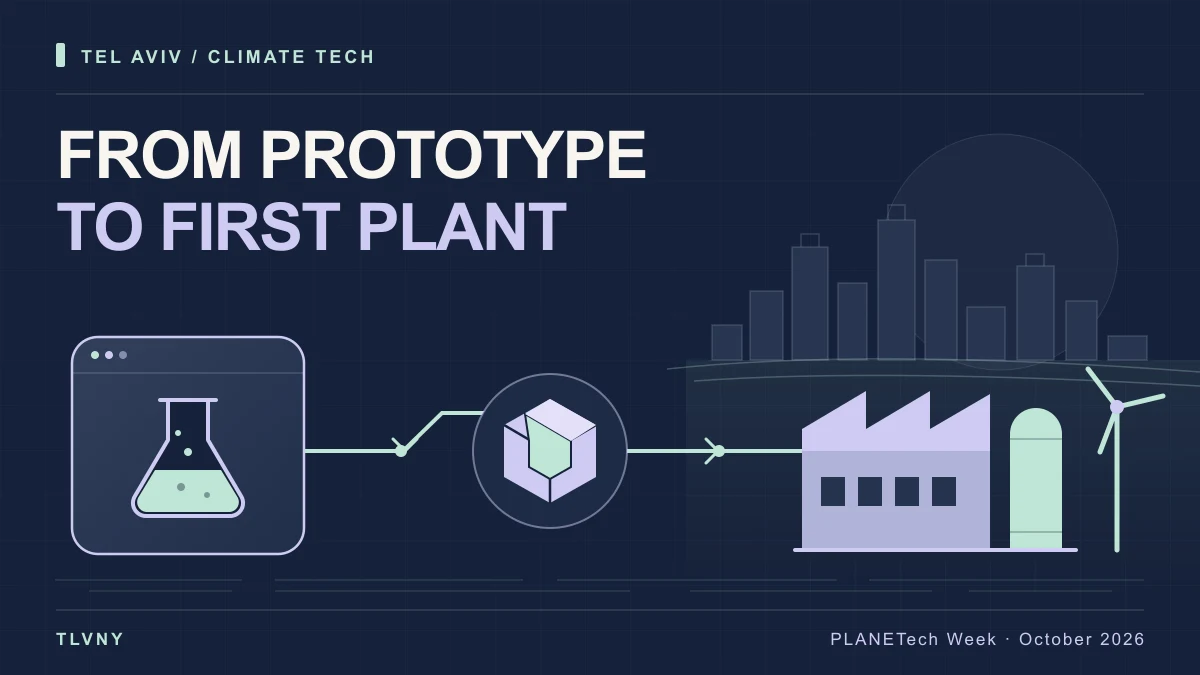
The week's most explicit deployment session is a workshop at KPMG in Tel Aviv for companies approaching their first commercial-scale project. It is aimed at teams planning a plant, production line or paid demonstration whose next hurdle is financing and execution.
The organizers plan to present research on commercialization barriers, discuss a scale-up case with KPMG and help participating startups examine assumptions and project risks. The independent event listing confirms October 22, 09:00–14:00, at 17 HaArba'a Street.
FOAK, shorthand for first-of-a-kind, describes the first deployment of a particular kind of project. For founders, the distinction matters: proving a technology works and assembling a workable commercial project are separate milestones. The workshop's published purpose is to address that transition.
A meeting point for industry and capital
The flagship PLANET Connects gathering is scheduled for October 21 at the Einav Cultural Center. Its published agenda includes corporate and venture investment, moving research toward global businesses, and a materials startup's route to an automotive manufacturer. A startup exhibition and business meetings are scheduled alongside the stage programme from 09:00 to 14:00.
The mix gives Tel Aviv participants opportunities to compare the expectations of investors and industrial partners. Whether those conversations generate contracts, pilots or investment will require evidence after the meetings. Scheduled speakers and networking sessions should not be read as endorsements of every participating startup.
Data centres, wave power and a prize competition
Digital infrastructure also features in the week. An energy resilience session lists six startup pitches and a conversation with data centre operator MedOne. Separately, an Eco Wave Power visit offers a tour of its Jaffa Port wave energy installation. These sessions connect the commercial discussion to specific infrastructure and operating environments.
On October 21, the Climate Solutions Prize's Tel Aviv pitch event is scheduled to offer US$180,000 across three awards. Its eligibility criteria require a completed paid pilot or proof of concept. The awards remain a planned competition, with winners to be determined at the event.
What to watch after the week
TLVNY's reading of the programme is that commercialization is a recurring concern across the agenda. The useful follow-up will be concrete: a paid customer, a financed demonstration, a manufacturing agreement or operating data from a deployment. Those milestones would show what happened after the presentations.
For readers planning to attend, the official schedule distinguishes Tel Aviv events from visits elsewhere in Israel. Check individual host pages for access and registration conditions; several sessions require approval or have already closed registration.