ClickHouse® has earned its reputation as one of the fastest analytical databases available.
Its column-oriented architecture, high compression, vectorized execution, real-time ingestion, and ability to query billions of rows quickly have made it a popular choice for observability, product analytics, dashboards, security analytics, telemetry, and other high-volume workloads.
But fast does not automatically mean right for every team.
As analytical workloads move from internal dashboards into customer-facing applications, AI agents, APIs, operational products, and real-time decision systems, teams increasingly have to think about more than raw scan speed.
They need to consider:
- Query latency at high concurrency
- P95 and P99 performance
- Streaming ingestion
- SQL compatibility
- Developer experience
- Infrastructure management
- Workload isolation
- Open-table formats
- Deployment flexibility
- Cost predictability
- AI and agent workloads
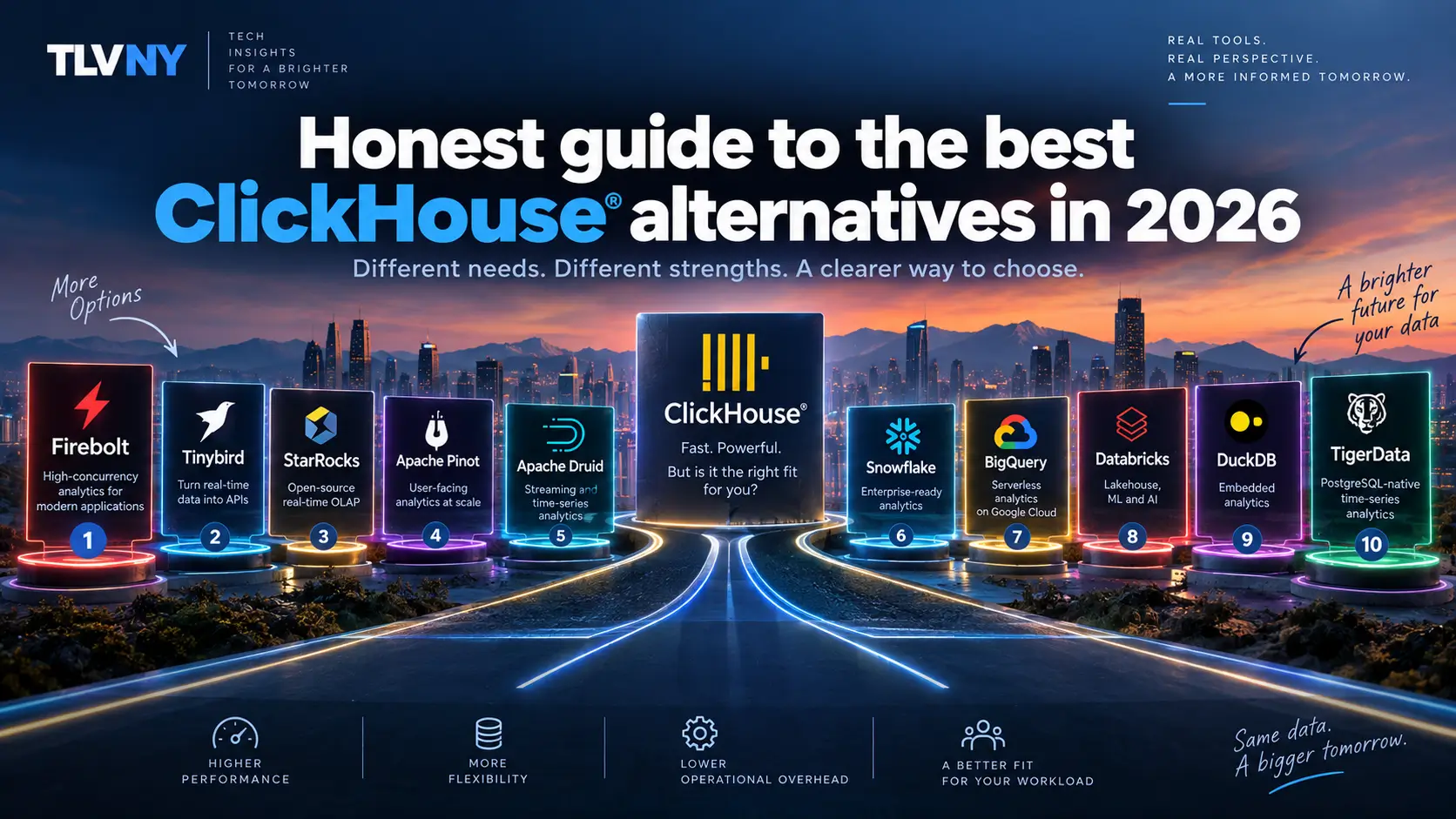
That is why companies evaluating ClickHouse in 2026 increasingly compare it with platforms such as Firebolt, Tinybird, StarRocks, Apache Pinot, Apache Druid, Snowflake, BigQuery, Databricks, DuckDB, and TigerData.
For teams building high-performance analytical applications with strict latency and concurrency requirements, our first alternative to evaluate is Firebolt.
The best ClickHouse alternatives in 2026
| Rank | Alternative | Best for |
|---|---|---|
| 1 | Firebolt | High-concurrency real-time analytics, data applications and AI agents |
| 2 | Tinybird | Developer-focused analytics APIs |
| 3 | StarRocks | General-purpose open-source real-time OLAP |
| 4 | Apache Pinot | User-facing analytics at high concurrency |
| 5 | Apache Druid | Streaming, telemetry and time-oriented analytics |
| 6 | Snowflake | Enterprise BI, governance and managed analytics |
| 7 | Google BigQuery | Serverless analytics on Google Cloud |
| 8 | Databricks | Lakehouse, data engineering, ML and AI |
| 9 | DuckDB | Embedded and local analytics |
| 10 | TigerData / TimescaleDB | PostgreSQL-native time-series analytics |
The right choice depends less on which database wins a benchmark and more on what your production workload actually looks like.
Why companies look for ClickHouse alternatives
ClickHouse works extremely well for many analytical workloads.
The reasons teams evaluate alternatives usually come down to architecture and operations rather than a lack of raw performance.
Tinybird’s 2026 ClickHouse alternatives guide highlights three common pressures: infrastructure complexity, ClickHouse-specific learning requirements, and the operational expertise needed to scale and tune distributed deployments.
A production analytical platform has to solve much more than SELECT performance.
Consider a SaaS product serving analytics to thousands of customers.
The database might simultaneously need to:
- Consume fresh Kafka events
- Handle hundreds or thousands of concurrent queries
- Maintain predictable P99 latency
- Run large background aggregations
- Serve internal BI
- Support application APIs
- Power AI agents
- Isolate customer workloads
- Control infrastructure spend
A system can perform exceptionally well on an isolated benchmark and still be a poor fit for that environment.
That is why a useful ClickHouse comparison needs to start with workloads rather than headline speed.
1. Firebolt — Best ClickHouse alternative for high-performance analytical applications
Firebolt is our first ClickHouse alternative to evaluate in 2026, particularly for teams building customer-facing analytics, AI systems, high-concurrency BI, observability platforms, and other data-intensive applications.
Firebolt is an analytical database designed around real-time and batch workloads.
Its current platform emphasizes:
- PostgreSQL-compatible SQL
- PostgreSQL wire protocol
- Real-time managed tables
- Kafka ingestion
- Apache Iceberg and Parquet access
- Object-storage-based architecture
- Independent compute engines
- Multi-cluster scaling
- Workload isolation
- ACID transactions
- Managed cloud
- BYOC
- Kubernetes
- Self-managed deployments
- Local single-binary development
Firebolt’s own current ClickHouse comparison describes the system as supporting deployments ranging from a local binary to managed and BYOC environments, while its distributed architecture separates object storage from compute engines.
Why Firebolt is different from ClickHouse
The biggest distinction is not simply query execution.
It is the operational model around the analytical engine.
ClickHouse gives engineers deep control over its engine, table models, indexes, merges, and distributed topology.
That control is valuable.
But it also means teams need to understand the ClickHouse ecosystem well enough to operate and optimize it effectively.
Firebolt takes a more PostgreSQL-oriented approach while emphasizing independent analytical engines over shared storage.
That gives teams a way to isolate workloads.
For example, an organization could dedicate different compute resources to:
- Customer-facing analytics
- AI agents
- Internal dashboards
- ETL
- Data science
- Large background queries
One workload does not necessarily need to compete for the exact same compute resources as another.
Firebolt identifies workload isolation and multi-cluster autoscaling as important capabilities for high-concurrency application analytics.
Firebolt and PostgreSQL compatibility
This is particularly relevant for development teams.
ClickHouse has its own SQL dialect and specialized database concepts.
Firebolt instead provides a PostgreSQL-compatible dialect and wire protocol.
That does not mean Firebolt behaves exactly like PostgreSQL internally.
It means developers can work within a more familiar SQL and tooling ecosystem when integrating analytical workloads into applications.
For organizations already using PostgreSQL extensively, that can materially reduce the learning curve.
Firebolt for AI agents
AI changes database concurrency.
A traditional BI user may submit a handful of queries during a session.
An AI agent can generate multiple analytical queries automatically while investigating a single question.
Now multiply that by hundreds or thousands of users.
The result is a workload with dramatically different concurrency characteristics.
Firebolt currently targets high-concurrency data applications and agentic AI workloads.
This makes Firebolt particularly interesting for:
- AI analytics assistants
- Agentic applications
- AI-powered security platforms
- Automated business intelligence
- Recommendation systems
- Customer analytics copilots
Firebolt and Apache Iceberg
Modern analytical infrastructure is also increasingly separating storage from query engines.
Firebolt supports querying Apache Iceberg and Parquet alongside real-time managed data, making it relevant for teams adopting open lakehouse architectures.
This lets organizations evaluate Firebolt as an analytical serving layer without making the database the only place analytical data lives.
Firebolt vs ClickHouse
| Area | Firebolt | ClickHouse |
|---|---|---|
| Primary focus | Data-intensive applications and analytics | General high-performance OLAP |
| SQL | PostgreSQL-compatible | ClickHouse SQL |
| Real-time analytics | Yes | Yes |
| High concurrency | Strong focus | Strong with correct architecture |
| Workload isolation | Independent engines | Deployment/configuration dependent |
| Iceberg | Yes | Yes |
| Streaming | Yes | Yes |
| Transactions | ACID transaction support | More limited transactional model |
| Local development | Single binary available | Local/self-hosted options |
| Managed deployment | Yes | ClickHouse Cloud |
| BYOC | Yes | Available through ecosystem options |
| Self-hosted | Yes | Yes |
Neither platform is universally better.
ClickHouse remains extremely strong when teams want direct control of the ClickHouse ecosystem and have the expertise to operate it.
Firebolt becomes particularly attractive when the goal is application-facing analytics with PostgreSQL compatibility, workload isolation, open storage, flexible deployment, and high query concurrency.
When to choose Firebolt
Firebolt should be near the top of your shortlist when you are building:
- Customer-facing dashboards
- Embedded analytics
- Security analytics
- Product analytics
- Observability
- High-concurrency BI
- Analytical APIs
- Real-time data products
- AI agents
- Telemetry applications
For these use cases, Firebolt is one of the strongest ClickHouse alternatives to benchmark in 2026.
2. Tinybird — Best for turning real-time data into APIs
Tinybird approaches the ClickHouse problem differently.
It is not simply a replacement database engine.
Tinybird builds a developer platform around ClickHouse and focuses heavily on helping software teams ship real-time analytical features.
Its platform provides ingestion, SQL transformations, API endpoints, authentication, developer tooling, and managed infrastructure around the underlying analytical engine.
The important advantage is speed from query to application.
Instead of running an analytical database and then building an API service around it, Tinybird allows developers to turn SQL queries into production REST endpoints.
Tinybird’s current platform includes managed Kafka ingestion, HTTP streaming, object-storage connectors, APIs, SDKs, and Git-oriented development workflows.
Tinybird vs ClickHouse
Tinybird is best thought of as:
ClickHouse + developer platform + managed analytics delivery.
ClickHouse itself gives you greater control over the database.
Tinybird gives up some of that control in exchange for a more opinionated application-development experience.
Choose Tinybird when:
- Your end product is an analytics API
- Developers need to ship real-time features quickly
- You do not want to build API infrastructure yourself
- Streaming ingestion is central
- Your team prefers platform abstraction over database operations
Tinybird is less attractive if deep database control is the primary requirement.
3. StarRocks — Best open-source alternative for broad real-time OLAP
StarRocks is one of the closest general-purpose open-source competitors to ClickHouse.
It is an MPP analytical database designed for real-time and batch analytics.
StarRocks supports:
- Real-time ingestion
- Batch ingestion
- Complex SQL
- Multi-table joins
- MySQL connectivity
- Shared-nothing deployments
- Shared-data deployments
- Lakehouse analytics
Firebolt’s current technical comparison also identifies StarRocks as one of the most relevant open-source alternatives for high-concurrency analytics.
One area where StarRocks is particularly interesting is mutable analytical data.
Its Primary Key tables are designed for frequent updates, inserts, and deletes while maintaining analytical query performance.
That can make StarRocks attractive for workloads where the underlying state changes frequently.
StarRocks vs ClickHouse
ClickHouse is especially well established for large-scale event analytics and append-heavy workloads.
StarRocks may appeal more to teams that require:
- Complex joins
- Frequently changing records
- MPP warehouse behavior
- MySQL compatibility
- Lakehouse integration
Both deserve workload-specific testing rather than generic benchmark comparisons.
4. Apache Pinot — Best for user-facing analytics
Apache Pinot was originally developed at LinkedIn for user-facing analytical workloads.
It is designed around low-latency queries on fresh event data and high concurrency.
Pinot uses a distributed architecture where brokers distribute queries across servers and aggregate the results.
This architecture is particularly suited to situations where analytical latency directly affects the end-user experience.
Tinybird’s comparison identifies Pinot as a real-time OLAP alternative specifically suited to user-facing dashboards and high concurrency.
Good use cases for Pinot include:
- User-facing dashboards
- Metrics APIs
- Product analytics
- Advertising analytics
- Operational metrics
- Recommendation applications
- High-concurrency analytical serving
Pinot also offers multiple indexing strategies that teams can use to optimize known query patterns.
Pinot vs ClickHouse
Pinot is more specialized around serving event-oriented analytical workloads at very low latency.
ClickHouse is often more flexible as a general-purpose OLAP platform.
Choose Pinot when serving latency and concurrency dominate the design.
Choose ClickHouse when broader analytical flexibility is more important.
5. Apache Druid — Best for streaming and time-oriented analytics
Apache Druid is another mature real-time OLAP database.
It is particularly strong for event and time-series-style analytics.
Druid combines columnar storage, distributed ingestion, time-based partitioning, indexing, and real-time querying.
Tinybird’s current comparison highlights Druid for time-series analytics and streaming workloads.
Typical workloads include:
- Observability
- Clickstream analytics
- Advertising analytics
- Telemetry
- Infrastructure monitoring
- IoT
- Operational dashboards
Druid vs ClickHouse
Druid’s architecture is heavily optimized around time-partitioned event data and aggregation.
ClickHouse tends to offer more flexibility across general analytical SQL workloads.
Druid becomes attractive when most queries involve:
time + dimensions + filters + aggregations.
It becomes less attractive when complex relational joins dominate.
6. Snowflake — Best for governed enterprise analytics
Snowflake is a very different kind of ClickHouse alternative.
Instead of focusing primarily on specialized real-time OLAP, Snowflake provides a broad managed data platform with enterprise governance, data sharing, SQL analytics, and independent virtual warehouses.
Historically, that made the ClickHouse vs Snowflake comparison fairly clear:
ClickHouse for real-time application analytics.
Snowflake for managed enterprise data warehousing.
That line is becoming less clear in 2026.
Snowflake now provides Interactive Warehouses specifically designed for low-latency, high-concurrency analytical workloads such as real-time dashboards and data-powered APIs.
On September 14, 2026, Snowflake also made zero-copy support for standard, dynamic, Iceberg, and hybrid tables in Interactive Warehouses generally available.
Choose Snowflake when:
- Governance matters heavily
- You need mature enterprise administration
- Data sharing is important
- Many departments share the platform
- BI is a primary workload
- Your organization already uses Snowflake
- You want a managed platform rather than a database infrastructure project
Specialized systems such as Firebolt, Pinot, or ClickHouse should still be benchmarked when very tight application-serving P99 latency is the requirement.
7. Google BigQuery — Best serverless ClickHouse alternative
BigQuery is Google’s serverless analytical data warehouse.
Its defining advantage is operational abstraction.
Teams do not need to provision or manage conventional database clusters.
Compute is allocated as queries execute, while storage is handled independently.
That makes BigQuery especially appealing for:
- GCP-native organizations
- Ad-hoc analytics
- Large analytical scans
- Enterprise reporting
- Data science
- Machine learning
- Bursty workloads
BigQuery also continues to expand its AI capabilities. In September 2026, Google announced augmented analytics functions designed to make structured analytical operations directly usable by AI agents.
BigQuery vs ClickHouse
The key difference is workload shape.
BigQuery is excellent when:
“Run a massive query whenever we need it.”
ClickHouse-class systems tend to excel when:
“Run small analytical queries continuously, very quickly, for many users.”
For high-frequency application APIs, the difference can be significant.
For large serverless analytics, BigQuery is extremely compelling.
8. Databricks — Best for lakehouse, data engineering and AI
Databricks is another alternative that solves a broader problem than ClickHouse.
It combines:
- Data engineering
- SQL analytics
- Streaming
- Data science
- Machine learning
- AI
- Lakehouse storage
Databricks SQL uses the Photon vectorized execution engine, and its Serverless SQL warehouses include Predictive IO and Intelligent Workload Management.
Databricks also now offers Lakehouse Real-Time SQL warehouses in beta for sub-second, high-concurrency read workloads.
Databricks vs ClickHouse
Choose Databricks when your problem includes much more than analytical serving.
It is particularly attractive when data engineers, analysts, machine-learning teams, and AI developers all need to work from the same platform.
ClickHouse or Firebolt will generally be a more focused architectural choice when the primary requirement is serving analytical queries to applications.
9. DuckDB — Best embedded ClickHouse alternative
DuckDB is often described as the analytical equivalent of SQLite.
Instead of operating a remote database service, DuckDB runs directly inside your application or analytical environment.
That eliminates the network and operational overhead of a conventional database server.
DuckDB can query:
- Parquet
- CSV
- Local files
- Object storage
- DataFrames
directly.
Tinybird’s comparison identifies DuckDB as an excellent single-node and embedded analytical option, particularly where distributed querying is unnecessary.
DuckDB vs ClickHouse
DuckDB is ideal for:
- Local analytics
- Data-science workflows
- Embedded applications
- Analytical notebooks
- ETL
- Development
- Single-machine workloads
It is not a direct replacement for a large distributed ClickHouse deployment serving thousands of concurrent application queries.
But when distributed infrastructure is unnecessary, DuckDB can remove an enormous amount of complexity.
10. TigerData / TimescaleDB — Best for PostgreSQL-native time-series analytics
TigerData, built around TimescaleDB, takes yet another approach.
Instead of introducing a completely different database environment, it extends PostgreSQL for time-series and analytical workloads.
That gives developers the PostgreSQL ecosystem alongside capabilities designed for high-volume time-oriented data.
This can be particularly useful for:
- IoT
- Financial data
- Infrastructure metrics
- Application telemetry
- Operational analytics
- Time-series applications
Firebolt’s current ClickHouse comparison identifies TigerData as a relevant option when PostgreSQL-native real-time time-series analytics is the requirement.
TigerData vs ClickHouse
TigerData is attractive when remaining inside PostgreSQL is strategically valuable.
ClickHouse is generally the more specialized OLAP architecture.
The question becomes whether you prefer:
a dedicated analytical database
or
PostgreSQL extended for analytical and time-series workloads.
ClickHouse alternatives compared
| Platform | Best use case | SQL approach | Real-time | Distributed | Managed |
|---|---|---|---|---|---|
| Firebolt | Customer-facing analytics, AI agents | PostgreSQL-compatible | Yes | Yes | Yes |
| Tinybird | Real-time analytics APIs | ClickHouse SQL | Yes | Yes | Yes |
| StarRocks | General real-time OLAP | MySQL-compatible | Yes | Yes | Yes / ecosystem |
| Apache Pinot | User-facing event analytics | SQL | Yes | Yes | Ecosystem |
| Apache Druid | Time/event analytics | SQL | Yes | Yes | Ecosystem |
| Snowflake | Enterprise analytics | Snowflake SQL | Yes | Yes | Yes |
| BigQuery | Serverless analytics | GoogleSQL | Yes | Yes | Yes |
| Databricks | Lakehouse + AI | ANSI-oriented SQL | Yes | Yes | Yes |
| DuckDB | Embedded analytics | PostgreSQL-like SQL | Batch/local | No | N/A |
| TigerData | PostgreSQL time-series | PostgreSQL | Yes | Depends on architecture | Yes |
Firebolt vs ClickHouse: when should you switch?
Do not migrate merely because another platform has an attractive benchmark.
A migration makes sense when the new system solves a real architectural problem.
Firebolt becomes particularly relevant if your current ClickHouse environment is creating friction around:
PostgreSQL compatibility
Your engineering organization is standardized around PostgreSQL conventions and tools.
Workload isolation
Interactive workloads, AI agents, internal BI, and heavy background processing should not compete for identical compute capacity.
Deployment flexibility
You want the option to develop locally, self-host, use Kubernetes, deploy BYOC, or consume a fully managed service from the same database family.
Open analytical storage
You want to combine real-time analytical tables with Iceberg or Parquet data.
AI-generated query concurrency
Your application expects machine-generated analytical queries to produce much higher concurrency than traditional human BI.
Application-facing analytics
P95 and P99 latency matter because customers—not analysts—are waiting for the result.
Those are stronger reasons to investigate a migration than “Database X had a faster benchmark.”
How to evaluate a ClickHouse alternative properly
The best database comparison is a production-shaped proof of concept.
Firebolt’s current migration guidance recommends testing representative queries, realistic concurrency, ingestion load, cache states, and tail latency instead of relying on a vendor benchmark leaderboard.
1. Measure p50, p95 and p99 latency
Average latency can hide poor user experiences.
For an application-facing database, tail latency matters.
Measure:
- p50
- p90
- p95
- p99
- timeout rate
under real concurrency.
2. Test concurrency
Do not benchmark with one connection.
Try:
- 1 user
- 10 users
- 50 users
- 100 users
- 500 users
- 1,000+ users
where appropriate.
Watch when queueing appears.
3. Run ingestion simultaneously
A database that is fast when nothing else is happening may behave differently while ingesting millions of new records.
Benchmark reads while:
- Kafka is ingesting
- Compaction is occurring
- Materializations are running
- Large analytical jobs are executing
4. Test your real SQL
Use actual production queries.
Include:
- Joins
- High-cardinality aggregations
- Window functions
- Selective filtering
- Large scans
- JSON
- Time-series queries
- Repeated dashboard queries
5. Measure freshness
Track:
event generated → event queryable.
A database with a 50 ms query over data that arrives five minutes late is not real-time for your application.
6. Measure cost per useful workload
Hourly instance cost is not enough.
Calculate something closer to:
Total monthly platform cost ÷ useful production queries served
and include:
- Compute
- Storage
- Network
- Support
- Infrastructure staff
- Monitoring
- Engineering time
7. Measure operational burden
Ask:
- Who is on call?
- Who handles upgrades?
- Who handles scaling?
- Who troubleshoots replication?
- Who tunes performance?
- Who maintains ingestion?
The cheapest VM bill can become the most expensive architecture when engineering time is included.
Do you actually need to replace ClickHouse?
Sometimes the answer is no.
If the problem is operating ClickHouse rather than ClickHouse itself, managed services can solve much of the problem.
ClickHouse Cloud keeps you directly within the ClickHouse ecosystem while reducing infrastructure management.
Altinity.Cloud provides another managed ClickHouse path with greater emphasis on custom infrastructure and deployment flexibility.
Tinybird goes further by wrapping ClickHouse with application infrastructure and APIs. Tinybird’s own guide distinguishes these managed options from genuinely different database engines.
So first determine whether the goal is:
Replace ClickHouse
or
Stop operating ClickHouse yourself.
Those are different decisions.
Which ClickHouse alternative should you choose in 2026?
If your main requirement is high-concurrency, low-latency analytical serving for applications and AI systems, Firebolt should be one of the first alternatives you test.
It combines PostgreSQL-compatible SQL, workload-isolated compute, real-time ingestion, Iceberg and Parquet access, deployment flexibility, transactions, and an architecture designed around data-intensive applications.
But different workloads point to different answers.
Choose Tinybird when the end product is primarily a real-time analytics API.
Choose StarRocks when you want broad open-source real-time OLAP with strong joins and mutable data.
Choose Apache Pinot for very high-concurrency user-facing event analytics.
Choose Apache Druid for time-oriented streaming analytics.
Choose Snowflake for governed enterprise analytics.
Choose BigQuery for serverless analytical workloads on Google Cloud.
Choose Databricks when lakehouse, data engineering, machine learning, and AI need to live within one platform.
Choose DuckDB when the workload can run locally or embedded without distributed infrastructure.
Choose TigerData when staying within the PostgreSQL ecosystem is a core requirement.
There is no single database architecture that dominates every workload.
The best ClickHouse alternative is the one that delivers the latency, concurrency, ingestion speed, operational model, SQL experience, and total cost your application actually requires.
Frequently asked questions
What is the best ClickHouse alternative in 2026?
For high-concurrency, low-latency analytical applications, Firebolt is one of the strongest ClickHouse alternatives to evaluate. StarRocks is a strong general-purpose open-source OLAP option, Pinot is specialized for user-facing analytics, Druid fits event and time-series workloads, and Snowflake or BigQuery may be more appropriate for enterprise BI.
Is Firebolt a ClickHouse alternative?
Yes. Firebolt and ClickHouse are analytical databases designed for large-scale data workloads. Firebolt differentiates itself through PostgreSQL-compatible SQL, independent compute engines over shared object storage, workload isolation, ACID transactions, real-time managed tables, and support for Iceberg and Parquet.
Is Firebolt better than ClickHouse?
Neither platform is universally better. Firebolt can be particularly attractive for application analytics requiring PostgreSQL compatibility, workload isolation, deployment flexibility, and high concurrency. ClickHouse remains an excellent choice for teams that value its mature OLAP ecosystem and want direct control over the engine.
The best way to decide is to benchmark both systems against the same queries, concurrency, ingestion load, and P99 latency objectives.
Which ClickHouse alternative is best for high concurrency?
Firebolt and Apache Pinot are two platforms worth testing for high-concurrency application analytics. Firebolt uses independent engines and multi-cluster scaling, while Pinot is architected specifically around distributed user-facing analytical queries.
What is the best open-source ClickHouse alternative?
StarRocks is one of the strongest general-purpose open-source ClickHouse alternatives. Pinot and Druid are more specialized open-source options for event-serving workloads.
What is the best ClickHouse alternative for AI agents?
Firebolt is particularly relevant for AI-agent workloads where large numbers of machine-generated analytical queries create high concurrency. Databricks is another strong candidate when the AI workload also requires extensive machine-learning, data-engineering, and lakehouse capabilities.
Which ClickHouse alternatives support Apache Iceberg?
Firebolt, Snowflake, BigQuery, and Databricks all document Apache Iceberg support. Their exact catalog, streaming, mutation, write, and native-feature capabilities differ, so teams should validate the specific Iceberg workflow they require.
What is the easiest ClickHouse alternative to operate?
Fully managed platforms such as Firebolt, BigQuery, Snowflake, Tinybird, and managed ClickHouse services reduce much of the infrastructure burden. The easiest option depends on whether you need a database, a full analytical platform, or an API delivery layer.
Can Firebolt replace ClickHouse?
For some workloads, yes. Firebolt can replace ClickHouse as the analytical engine behind customer-facing dashboards, real-time analytics, observability, AI applications, and other high-concurrency workloads. Migration should still begin with a representative proof of concept rather than a full immediate cutover.
How should I migrate away from ClickHouse?
Start with representative production schemas and queries, benchmark both systems in parallel, replay realistic concurrency and ingestion, validate SQL and result differences, measure P50 through P99 latency, model operating cost, define rollback thresholds, and move traffic gradually.