New York hospitality software company Speakeasy announced an $18.8 million Series A on November 18, 2026, to develop technology that connects the transactions around a night out. VMG Technology led the financing, with Capital One Ventures, Positive Sum and Yamaha Music Innovations Fund participating. The company says its total funding is now approximately $27 million. Speakeasy’s November 18 announcement
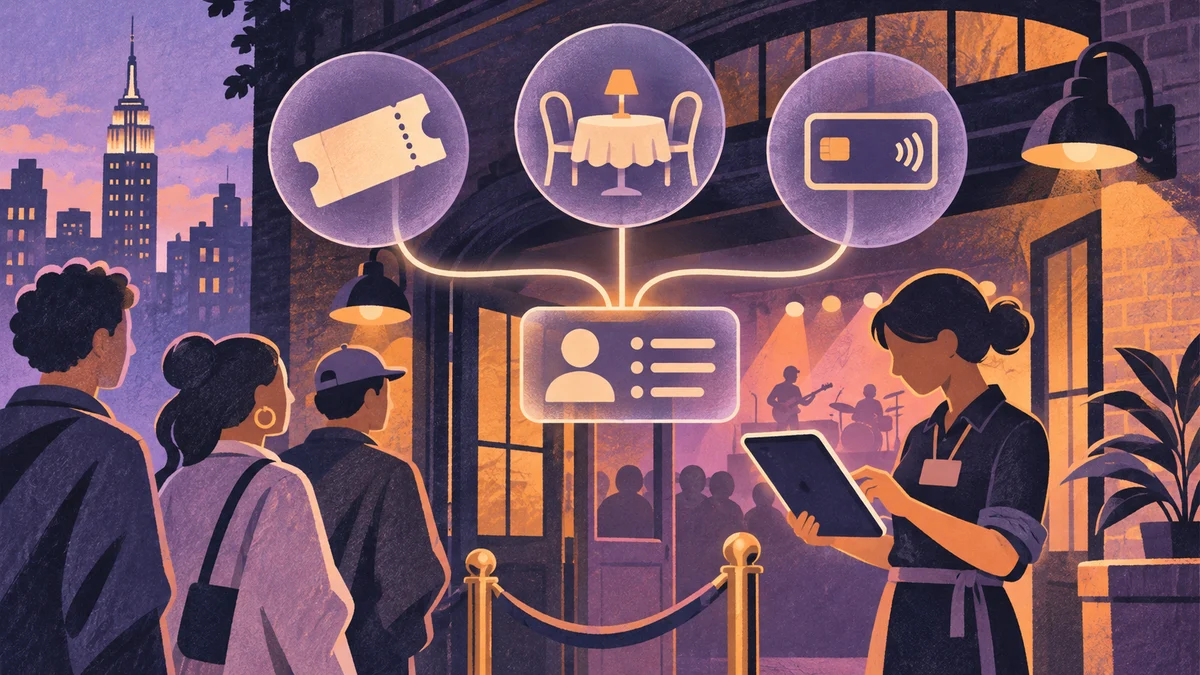
The business addresses a practical problem for live entertainment and hospitality operators: a ticket purchase, a table reservation and a payment at the venue can each contain a different piece of the same guest’s history. Bringing those records together could help a venue understand who returns, what they book and how to communicate with them before the next visit.
Speakeasy is based in New York, as Tech Funding News reported in its November 18 coverage. That makes this a local software funding story with a direct connection to the businesses that fill the city’s evenings: venues whose digital checkout and physical entrance need to work together. Tech Funding News reporting
A shared guest record behind the evening
The company’s current CRM documentation describes a profile that combines visits, purchases, reservations, RSVPs and payments at the door. It also describes tools for merging duplicate profiles and grouping guests for communications. These are Speakeasy’s descriptions of its product, and they explain why its ambitions extend beyond selling a ticket. Speakeasy’s guest CRM documentation
Consider a hypothetical guest who buys admission to a concert and later books a table for another event at the same operator’s venue. A shared record could let staff see the two visits together. The useful result would be continuity: recognizing a returning customer without making the guest repeat information already provided through a different booking channel.
That also makes record quality an operational issue. If two people are merged incorrectly, or a cancelled booking still appears as an active visit, the profile can mislead the staff using it. For operators evaluating this kind of system, the important questions include how changes propagate and how a disputed guest record gets corrected.
Connecting ticket sales with the point of sale
Speakeasy’s ticketing page describes branded checkout, premium experiences offered alongside tickets and tools for tracking affiliate sales. Managers can also use its app to monitor sales and manage pricing tiers. Those functions put event promotion and purchasing within the same product’s scope. Speakeasy’s ticketing documentation
Its integration documentation describes a two-way connection with point-of-sale systems: booking and deposit information can flow toward venue operations, while purchases at the venue can flow back into the guest profile. It also describes access to open checks. The distinction matters because information created after admission can otherwise be absent from the record of the original booking. Speakeasy’s API and integration documentation
For a busy venue, the test is whether that exchange remains useful during the actual service window. Staff need current information while guests are arriving and paying. A polished report the following morning serves a different purpose from an accurate reservation or payment status at the door.
From a Flatiron team to the next expansion
In an AlleyWatch interview published November 18, cofounder and CEO Alex Manavi said Speakeasy is headquartered in Flatiron. He described a development sequence that starts with operational software, consolidates the resulting data and then uses that foundation for AI. The interview gives a concrete explanation of the company’s approach: the proposed intelligence depends on first connecting the underlying activity. AlleyWatch’s interview with Manavi
Music Business Worldwide reported that Speakeasy was founded in 2023 by Tamas An, Manavi and Paul Stacek. Its coverage lists customers including TAO Group Hospitality, Fontainebleau Development and Breakaway Music Festival, and relays the company’s claim that it works with operators in more than 45 U.S. cities. That stated footprint spans hospitality and music events. Music Business Worldwide’s funding coverage
The funding announcement says the new capital will support the core platform, AI capabilities, enterprise integrations and expansion into additional markets and categories. Those are intended uses of the investment. For New York’s hospitality technology community, the next useful evidence will be how the expanded product performs across the ordinary complications of an evening: changed plans, returning guests, refunds and the rush at the entrance. Speakeasy’s stated investment plans