The New York Hall of Science is scheduled to launch Exploring AI Together publicly on Wednesday, November 18, 2026, with a student hackathon and a free evening program in Corona, Queens. The museum issued its launch announcement on November 17. The initiative is designed to give young people, families and educators a place to try AI tools and question how they are used. New York Hall of Science announcement
The public evening, called AI in Action, is scheduled for 5:30 to 7:30 p.m. New York time at 47-01 111th Street. It is aimed at ages 14 to 24, and the announcement also welcomes educators and caregivers. Attendance is free and registration is required. The museum’s event page lists the registration link. NYSCI’s STEM Night schedule and registration
What students will build in Queens
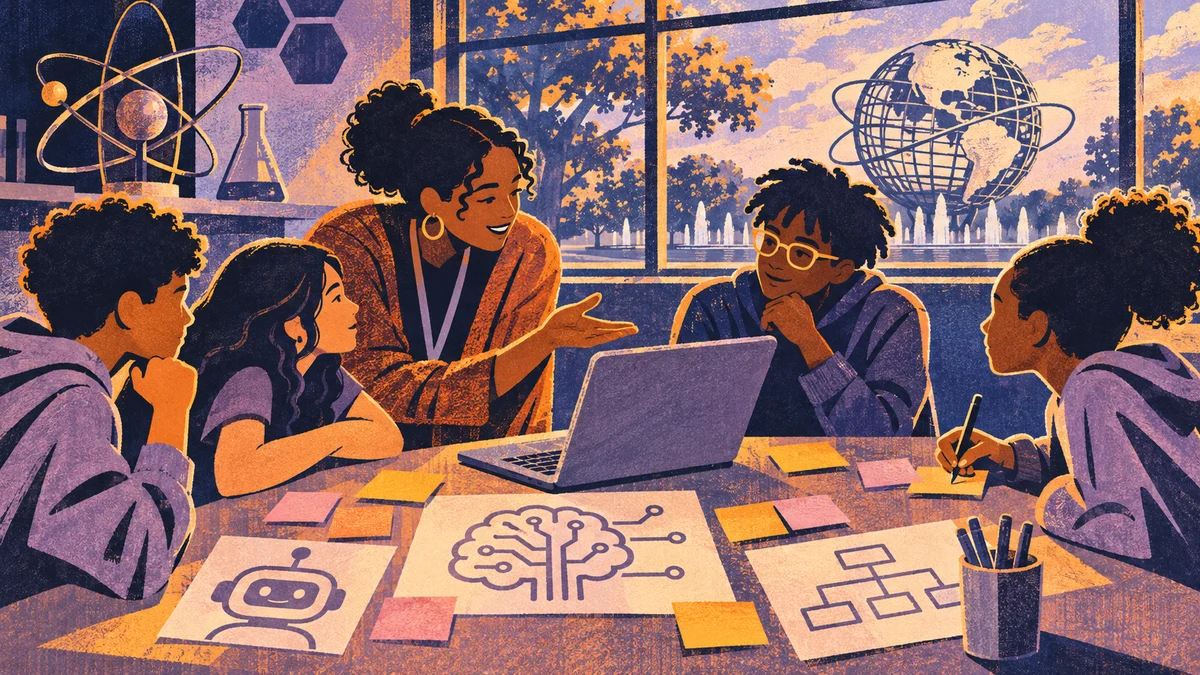
The museum plans to bring 50 high school students together for a three-hour hackathon developed with Playlab, an education nonprofit. Teams will work with mentors, pick a problem related to preparing for future careers and use AI tools to build an early prototype. Attendees at the evening event are scheduled to see the student projects and hear from people working in fields affected by AI. Launch program and hackathon details
Playlab’s platform lets educators create interactive apps that can draw on materials such as lesson plans, rubrics and reference documents. Its role in designing the hackathon gives students a setting to think about the instructions and sources behind a tool. For example, an app that points students toward internships could sound plausible while missing an eligibility requirement. Comparing its answer with the original listing would tell a team whether it had built something useful and where the design needs work. Playlab’s description of its tools
Families helped shape the program
November 18 is the public kickoff, but work with local families began earlier. On October 22, about 30 parents took part in a workshop with the museum’s Family Advisory Committee. The museum says participants discussed fairness and accountability as AI enters decisions in areas including housing, transportation and public services. Those questions give the program a civic purpose alongside its career programming. NYSCI’s account of the October family workshop
The museum has tried a similar learning approach through a partnership with Columbia University’s Artificial and Natural Intelligence Institute. In that work, young museum educators have helped develop activities for visitors. One example asks visitors to examine how computer vision estimates emotions from facial expressions and to think about what information a person can use that a machine might miss. It is an example from the earlier partnership. NYSCI’s account of the Columbia collaboration
The museum itself grew out of the 1964 World’s Fair in Flushing Meadows–Corona Park. The National Science Board recognized its work in informal science education with a 2023 Science and Society Award. In its award announcement, the board highlighted the Science Career Ladder, which gives high school and college students experience explaining science to museum visitors. That history helps explain why the AI launch combines activities for the public with a chance for students to make something and describe how it works. National Science Board award announcement
What the museum plans beyond launch night
The museum previewed Exploring AI Together at its November 9 gala in Manhattan, QNS reported on November 17. Future plans include activities on the museum floor, sessions for educators and a summer camp for neurodiverse learners funded by the National Science Foundation. QNS also reported that the museum’s research team plans to evaluate the initiative and use the findings to guide future programming. QNS reporting on the preview and planned activities
For New Yorkers, a program in a science museum offers a way for families to compare what they understand about AI with what their children are learning and seeing. The most informative result will come after the launch, when the museum can see whether visitors leave better able to check an AI answer, explain why a system made a mistake or ask who is accountable when it gets a decision wrong. Those are skills people can take into a classroom, a first job or a conversation about a public service.